The next phase of President Donald Trump's agenda is taking shape. After months of executive orders and policy announcements, attention is shifting to implementation. Agencies are rolling out new programs, advancing regulations and opening consequential proceedings, while lawmakers confront a packed slate of policy debates. POLITICO's policy teams will be tracking the key developments, deadlines and decisions that will shape Washington in the weeks ahead. |
— The FAA is accelerating AI adoption across aviation safety and air traffic operations. — Companies face key July deadlines to influence Trump's evolving tariff and trade agenda. — Disney's FCC battle is emerging as an early test of the Trump administration's media agenda. |
Agriculture— Farm bill showdown: Senate lawmakers have teed up their version of the farm bill. Senate Ag Chair John Boozman (R-Ark.) has said he plans to mark up the bill before the chamber recesses for its August break. Several controversial provisions sought by Republicans didn’t make it into Boozman’s bill. The proposal also omits a Democratic priority to delay a requirement that states begin sharing the cost of the Supplemental Nutrition Assistance Program benefits. That could make it much harder to move the historically bipartisan bill through Congress. House Ag Chair G.T. Thompson (R-Pa.) is expected to unveil his long-expected farm-labor bill, legislation that would allow dairy farms to employ foreign agricultural workers year-round for the first time. — USDA reorganization: Federal employees are learning their new duty stations and deciding whether to relocate from the Washington region to hubs around the country. USDA has released reorganization plans for the Foreign Agricultural Service, the Farm Production and Conservation mission area, the Forest Service and the newly renamed Food and Nutrition Administration. Documents obtained by POLITICO show the reorganization must be completed within a year, though department officials have said some employees may be required to move sooner. — MAHA regulations: The Food and Drug Administration has yet to release its long-awaited definition of ultra-processed foods, a rule that could have sweeping implications for federal procurement and nutrition policy. Health Secretary Robert F. Kennedy Jr. has said the definition is imminent and that the FDA will move quickly afterward on front-of-package nutrition labeling. Separately, a federal judge in June blocked USDA waivers allowing five states to restrict purchases of foods such as soda and candy through SNAP. Because the agency relied on the same legal authority for other state waivers, the ruling could have broader implications for one of the Make America Healthy Again movement's signature initiatives. —Screwworm threat: Confirmed U.S. cases of the New World screwworm continue to climb, while USDA remains far short of the sterile fly production needed to contain the pest's spread. A new facility in Mexico opened this month and is expected to eventually produce 100 million sterile male flies, but analysts estimate roughly 500 million must be produced each week to control the outbreak. Former USDA employees say internal spending reviews delayed the facility's opening by months. The flesh-eating parasite can kill livestock, impose costly treatment expenses on ranchers and, ultimately, put additional upward pressure on beef prices. — Marcia Brown |
Trade— USTR July sprint: July will be a pivotal month for companies and governments looking to shape the Trump administration’s trade agenda. Public comments are due today on the Office of the U.S. Trade Representative’s proposed 25 percent tariffs on Brazil over a range of trade disputes, and on Thursday for a similar probe into Vietnam’s intellectual property protections. Companies also have until Sunday to request the continuation of certain China tariffs imposed during Trump's first term that former President Joe Biden later maintained and expanded. Later this month, USTR will hold a public hearing in the Brazil investigation and another on proposed tariffs on 60 countries’ efforts to curb imports made with forced labor. The agency will also close public comments on the proposed U.S.-China “board of trade,” which would manage bilateral trade relations. — USMCA review begins: July 1 has been circled on trade watchers' calendars for another reason: it marks the formal start of the six-year review of the U.S.-Mexico-Canada Agreement, the North American trade pact Trump signed during his first term. The three governments meet virtually today to launch the review, but the United States and Canada remain far apart on a path toward extending the agreement, according to U.S. Ambassador to Canada Pete Hoekstra. In an interview broadcast Sunday on Canada’s CTV News, Hoekstra said the two countries are not “close to announcing any type of a framework or an interim agreement.” He echoed recent comments from Canadian Prime Minister Mark Carney that any breakthrough in the negotiations will have to come from the highest levels of government. “The next discussion, again, has to be a discussion between potentially the president and the prime minister,” Hoekstra said. Talks with Mexico, which U.S. officials have described as further along, are continuing, with negotiators expected to meet next month for a third round of talks. If the three countries don’t reach an agreement this year to extend the deal for another 16 years, they will meet annually for the next 10 years in an effort to renew the agreement before its expires in 2036. — Oliver Ward |
Financial Services— SEC reporting: Public comments about the Securities and Exchange Commission’s proposal to shift to twice-yearly reporting for U.S. public companies are due in early July, setting the stage for the agency to begin drafting a final rule. Watch for sharp reactions from Wall Street, where some major firms have been signaling concern about moving away from quarterly reporting for months. A trio of industry groups has urged the agency to extend the comment window, citing the July 4 holiday. — Crypto bill: Senators are aiming for a floor vote on a sweeping sweeping legislation that would divide oversight of digital assets between federal regulators. The bill will need bipartisan support to pass, and several issues remain unresolved. Lawmakers need to negotiate a government ethics provision governing how federal officials can engage with digital assets, addressing Democrats’ concerns about the Trump family’s crypto businesses, Law enforcement groups also continue to object to a provision known as the Blockchain Regulatory Certainty Act. — More commissioners: As Congress races to reach a deal on the digital assets bill, another outstanding issue is whether lawmakers can agree to fill vacancies at the agencies that regulate Wall Street and would oversee the digital asset markets. Three of SEC’s five commissioner posts are filled while the Commodity Futures Trading Commission has just one commissioner, Chair Michael Selig. Lawmakers from both parties involved in the crypto negotiations have called for additional nominees. Separately, Federal Reserve Chair Kevin Warsh is scheduled to testify before Congress for the first time, during the week of July 13. — FinCEN scrutinized: Treasury's anti-money laundering bureau heads to Capitol Hill on July 21 as House lawmakers review the Trump administration's plans for the Financial Crimes Enforcement Network, which has become central to its crackdown on cross-border payments, fraud and illicit finance. Lawmakers are expected to press officials on implementation of the Corporate Transparency Act's beneficial ownership reporting requirements, as well as efforts to expand FinCEN's role alongside banking regulators in anti-money laundering supervision. — Non-profits: Public comments close July 13 on an Office of Management and Budget proposal that would give political appointees authority to approve or cancel federal grants for nonprofits, states and local governments. Industry and consumer advocates argue the change could slow affordable homebuilding nationwide — contrary to lawmakers’ recently enacted bipartisan legislation intended to boost housing supply by reducing regulatory red tape. — Mark McQuillan |
Tax— Chief counsel, take two: The Senate Finance Committee is gearing up to question the Trump administration’s nominee for IRS chief counsel following the nomination of attorney Jim Gadwood to the long-vacant post. If confirmed, Gadwood, currently the vice-chair of the tax practice at boutique law firm Miller & Chevalier, would oversee nearly 2,000 attorneys responsible for writing regulations implementing federal tax law — like last year’s GOP megabill — and represent the government in the U.S. Tax Court. Democrats on the Finance Committee are already eager to press Gadwood on acting Attorney General Todd Blanche recent decision to exempt President Trump and his business interests from years of IRS audits as part of the settlement ending Trump’s lawsuit against the agency over the leak of his tax returns. Filling the chief counsel role — one of only two Senate-confirmed posts at the IRS, along with the still-vacant commissioner’s job — has been a struggle in Trump’s second term. The administration’s first nominee, Donald Korb, was scuttled last November after far-right activist Laura Loomer, a Trump ally, criticized his past donations to Democrats and favorable words about them. — Doing it live: The administration is looking to make a splashy July 4 launch of Trump Accounts, the new tax-advantaged investment funds for children born between 2025 and 2028, when they begin accepting contributions and government seed money. But questions linger about how smoothly the government is implementing the program, created as part of last year’s tax overhaul. The Center for Taxpayer Rights, a nonprofit led by former IRS national taxpayer advocate Nina Olson, called the Trump Accounts mobile app — developed by the Bank of New York and Robinhood — “so amateurish” in its design it could discourage participation. And the libertarian-leaning Cato Institute worries Trump Accounts may not be as accessible to lower-income families. — Benjamin Freed |
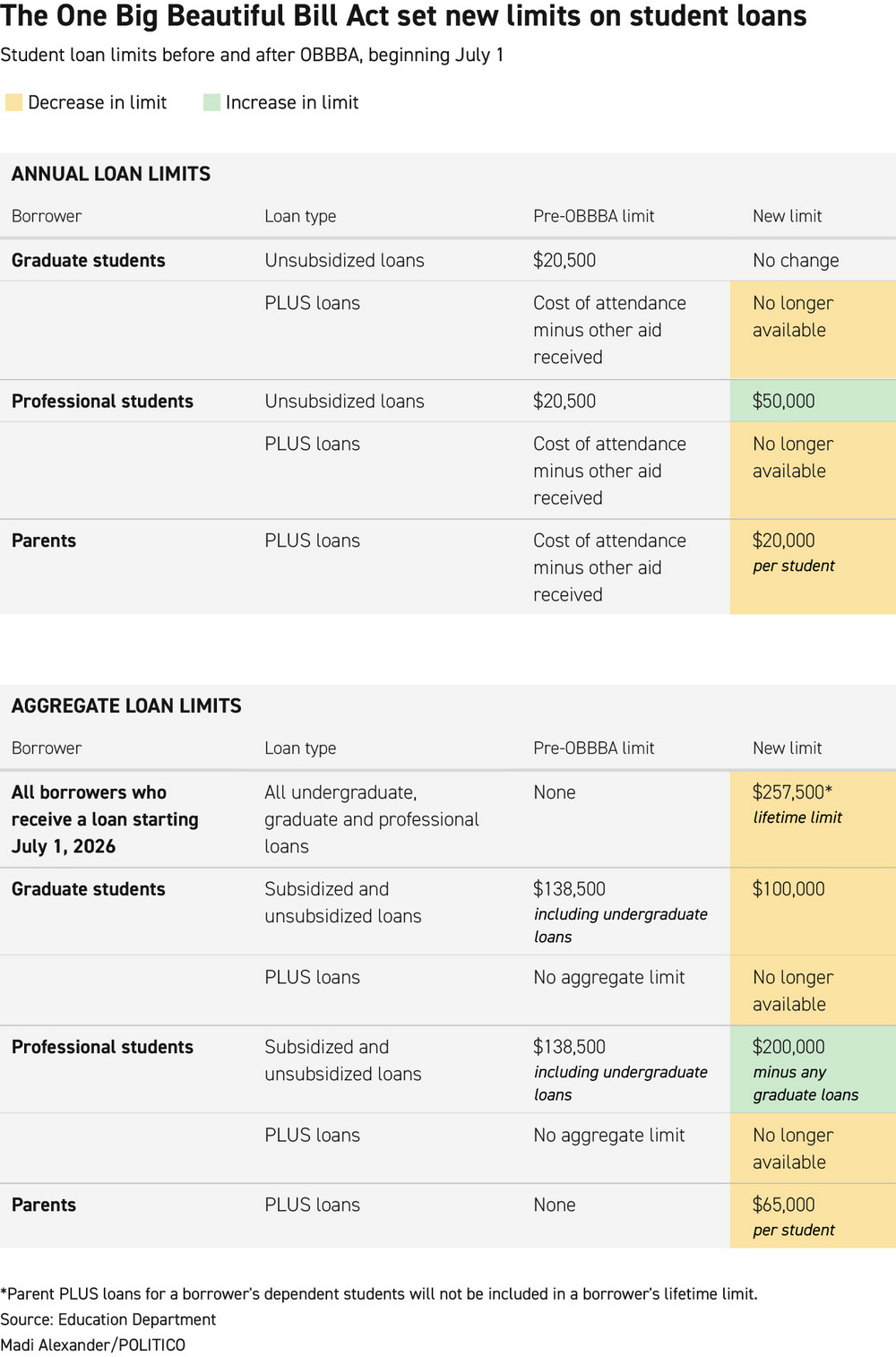
Education— Student aid overhaul launch: July 1 is expected to mark the start of one of the biggest overhauls of higher education policy in nearly two decades. The Trump administration has moved aggressively to implement policies from by the GOP’s One Big Beautiful Bill Act, the domestic policy package signed into law last summer, along with additional administration priorities. Here’s what’s taking effect this month: - Student loan caps: New federal loans caps for graduate students will be set at $20,500 per year, with a $100,000 aggregate limit. Students in professional programs will be able to borrow up to $50,000 per year, with a $200,000 aggregate limit.
- Workforce Pell Grants: The new program allows Pell Grants, traditionally reserved f or low-income students pursuing degrees, to be used for job training programs as short as eight weeks. Eligible programs must be approved by a state’s governor and the Education secretary and must meet annual performance metrics.
- Loan repayment plan changes: The Education Department will phase out the Biden-era Saving on a Valuable Education program and launch a new repayment program known as the Repayment Assistance Plan. More than 7 million borrowers will have to enroll in another plan to repay their student debt.
- Public Service Loan Forgiveness: The department has revised which employers qualify for the Public Service Loan Forgiveness program, seeking to exclude borrowers whose employers engage in activities the Trump administration considers illegal.
- Rule still pending: The Education Department has yet to finalize its rule creating a new accountability metric based on the earnings of graduates from undergraduate programs. If graduates do not earn as much as a typical high school graduate, the program will no longer be eligible for federal student loans.
— K-12 FUNDING DISTRIBUTION: The department is expected to make billions in education dollars, known as formula funds, available to states on July 1. In this year's government spending law, Congress has explicitly required the department to distribute the funding for key programs — including support for high-poverty schools, special education and career and technical education — by that date. It’s a move that came after the Trump administration withheld billions of education funding last year that is typically made available on July 1. — Bianca Quilantan and Mackenzie Wilkes |
 | |
Defense— Senate defense action: The Senate is expected to begin debate on its version of the annual defense policy bill when lawmakers return from the July Fourth recess. The chamber’s deliberations will provide a key test of support for President Trump's proposed $1.15 trillion defense budget. The legislation will need at least some Democratic support to clear the Senate’s 60-vote threshold for advancing. But early signs point to a difficult path. A majority of Democrats on the Senate Armed Services Committee voted against the bill during the panel’s closed-door mark-up last month. Democrats have expressed reluctance to back a record-breaking Pentagon budget with few constraints on the Trump administration actions, including the Iran war, military operations targeting suspected drug-smuggling vessels in the Caribbean and National Guard deployments to U.S. cities. Republican and Democratic leaders will also need to negotiate agreements on amendments, setting up potentially difficult national security votes less than four months before the midterm elections. Meanwhile, Senate appropriators haven’t made progress on advancing companion defense funding legislation. Chair Susan Collins(R-Maine) and ranking member Patty Murray (D-Wash.) remain at odds over how to distribute funding across the 12 annual government spending bills. Murray has vowed that Democrats will not support major increases to the Pentagon budget without corresponding consideration for domestic programs. — Connor O’Brien |
Health Care— Info blocking crackdown: The Trump administration's health tech agency is targeting hospitals, doctors and others that stand in the way of health data sharing. Thomas Keane, the National Coordinator for Health IT, is working to ensure patient health records and other medical data flow seamlessly among providers, insurers and patients. That means penalizing entities that fail to comply with federal rules requiring easy access to and exchange of patients’ electronic health information. The office has begun issuing notices to violators, along with corrective action plans. Failure to comply could bring penalties as high as $1 million per violation. The HHS Office of Inspector General is staffing up with lawyers and investigators as it reviews through more than 2,000 complaints related to information blocking. Congress directed the Department of Health and Human Services, which houses the the health IT office, to prevent health care organizations from hoarding patient data under the 2016 21st Century Cures Act. The health IT office finalized rules implementing the law in 2020 and penalties in 2024, but enforcement has only recently begun. — Hospitals vs. drugmakers: Senate Health Chair Bill Cassidy wants to overhaul the controversial 340B program, picking a fight with hospitals over a benefit that gives facilities serving large numbers of low-income patients steep drug discounts. The Louisiana Republican has released a discussion draft outlining several changes, including increased transparency requirements aimed at ensuring the discounts help low-income Americans. Cassidy argues the program has grown too large and has limited oversight. The draft is the latest salvo in a yearslong lobbying fight between the drug industry and hospitals over 340B, which Congress created in 1992 to require drug companies to provide steep discounts to safety-net hospitals participating in Medicare or Medicaid. Drug companies argue the program has become too unwieldy, while hospitals counter that it is essential to helping safety-net facilities operating on thin margins to access costly medicines. Although 340B reforms have drawn bipartisan support in the past, hospitals had enough allies on Capitol Hill to block them. — Health Care Pro Team |
Transportation— The FAA’s big AI push: The Federal Aviation Administration is deploying artificial intelligence on two fronts — one focused on preventing tomorrow's safety risks and another on managing today's air traffic. The agency's partnership with technology firm Palantir uses decades of aviation data to identify emerging safety trends before they lead to airport incursions or other potential safety risks across the national airspace system. Palantir’s “Foundry” tool helps FAA safety analysts understand where risk is increasing across the aviation system. Separately, the FAA awarded a contract to Air Space Intelligence for a program dubbed SMART, which is designed to optimize the day-to-day flow of aircraft through national airspace. The system analyzes weather, flight schedules, aircraft positions and airspace constraints to forecast congestion and conflicts hours — or even days — in advance. The hope is that it will give controllers more opportunities to reroute flights before bottlenecks develop. FAA officials have emphasized that neither system is intended to replace human decision-making. Instead, the tools are designed to provide air traffic managers and safety officials with better information earlier, before problems emerge. —Safety bill stall: House and Senate lawmakers are running out of time to reconcile competing aviation safety bills before the midterm elections. The measures take different approaches to requiring certain aircraft to carry advanced tracking technology that allows pilots to receive real-time information about nearby aircraft — a proposal driven by last year's fatal midair collision over Washington. At the center of the disagreement between the House's ALERT Act and the Senate's ROTOR Act is a debate over ADS-B In, the cockpit technology that lets pilots view nearby aircraft in real time and that safety advocates say could help prevent future midair collisions. Lawmakers could still use the annual National Defense Authorization Act as a vehicle for the aviation safety provisions, though negotiations have made little progress. FAA officials have also said the agency is exploring taking regulatory action independent of Congress, including how to address NTSB recommendations stemming from the crash. — Surface transportation deadline: The calendar is becoming a factor for the surface transportation authorization. Lawmakers have begun discussing what a short-term extension of current authorities might look like if Congress misses the Sept. 30 deadline for a new bill. Sen. Shelley Moore Capito(R-W.Va.), chair of the Senate Environment and Public Works Committee, has said she remains focused on finishing the bill on time but acknowledged that, if an extension becomes necessary, she envisions one lasting only until the end of the year — not a full year. Such a stopgap would give negotiators additional time after the November elections to complete the legislation, though Capito has made clear that remains a fallback option: "I don't want to do that. I want to finish in September." — Oriana Pawlyk |
Technology— Disney fight beats on: Multiple deadlines in Disney’s ongoing tussle with the Federal Communications Commission fall in July as the company battles over its broadcast licenses and the daytime TV show “The View.” A second round of comments is due July 6 on whether to grant the Disney’s request to treat “The View” as bona fide news, exempting it from the agency’s longtime equal time requirements for rival political candidates. ABC has defended that designation, arguing that applying equal time rules could chill speech, while GOP campaign operatives say the rules should apply. Meanwhile, ABC and its allies have until July 29 to respond to petitions seeking to block renewal of its eight broadcast TV station licenses submitted at the end of June. FCC Chair Brendan Carr bought up these licenses for early review — years ahead of schedule — citing a diversity probe into the company. GOP groups raised a range of complaints against Disney, including allegations of liberal bias in certain shows. — Kids Online Safety back on the agenda: Lawmakers in both chambers are poised to continue negotiations over children's online safety legislation in July following a flurry of activity in June. Sen. Marsha Blackburn (R-Tenn.) is negotiating with the White House on a package that would pair limited preemption of state AI laws with several children's online safety bills, including the App Store Accountability Act, the NO FAKES Act and the Kids Online Safety Act (KOSA). Meanwhile, House Energy and Commerce Chair Brett Guthrie (R-Ky.) and ranking member Frank Pallone(D-N.J.) have advanced the bipartisan KIDS Act, which includes KOSA and other online safety measures. The House package, however, omits the Senate version's of the "duty of care" provision, setting up a key point of contention if lawmakers attempt to reconcile the two approaches. — AI rules of the road: July will also test whether the Trump administration can provide greater certainty around its emerging approach to regulating frontier AI models. After blocking foreign nationals from accessing Anthropic's Mythos 5 and Fable 5 models over cybersecurity concerns, the administration on Friday partially lifted restrictions on Mythos 5 for a limited group of approved companies and agencies, while Fable 5 remains restricted. The White House also asked OpenAI to limit the rollout of its latest GPT-5.6 model while similar security concerns are evaluated. The administration says it wants to preserve U.S. leadership in AI while addressing national security risks, but companies and trade groups are increasingly calling for a more formal review process. Industry will be watching in July for signs the White House intends to move beyond case-by-case interventions toward a more predictable framework for evaluating advanced AI models. — John Hendel and Owen Dahlkamp |
Cybersecurity— Cyber’s July agenda: Congress returns from the July Fourth recess to a packed cyber policy agenda, including efforts to establish stronger guardrails on artificial intelligence models, revive a key surveillance law and advance funding bills for the coming fiscal year. Meanwhile, White House officials, including National Cyber Director Sean Cairncross, are working to secure the rollout of advanced, cyber-capable AI models while allowing trusted companies to deploy them to strengthen their cybersecurity defenses. Trump signed an executive order last month directing AI developers to voluntarily submit their models to the federal government for review 30 days before public release. Another initiative required by the order, an AI security clearinghouse that would coordinate federal agencies and private sector companies to fix critical security vulnerabilities identified by advanced models is also expected to begin operating this month. On Capitol Hill, lawmakers are scrambling to find a path to renew Section 702 of the Foreign Intelligence Surveillance Act, which officially lapsed last month. Congress appeared poised to reauthorize the law, which allows the intelligence agencies to collect communications data involving non-Americans without a warrant. But Trump has since said he will sign a Section 702 extension until Congress passes a voter ID bill members of his own party say is a non-starter — raising the prospect the spy program could remain dormant indefinitely. — Appropriations watch: The Senate Appropriations Committee is expected to release its Homeland Security spending bill, which funds the Cybersecurity and Infrastructure Security Agency. The House Appropriations Committee has already approved legislation providing roughly $2.4 billion for CISA in fiscal 2027, along with $50 million for the State and Local Cybersecurity Grant Program. And two key cyber leadership roles remain vacant— but that could change this month. The Senate could vote on the Adam Cassady's nomination to serve as the State Department’s next cyber ambassador at any time, while Trump is expected to soon announce a nominee for director of CISA, which has remained without a Senate-confirmed leader since January 2025. — Maggie Miller, Dana Nickel and John Sakellariadis |
|


No comments:
Post a Comment